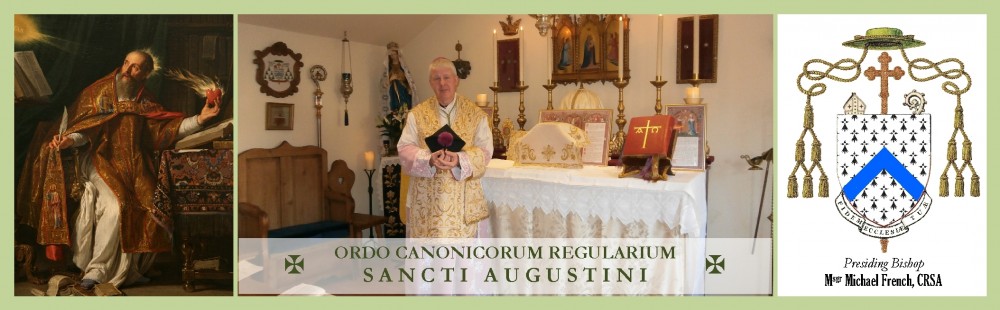
Mission Statement Independent Roman Catholic Community
We
are a small group of Traditionalist Catholics existing to preserve the
Traditional practices of the church. We adhere solely to the Rite of
Mass Codified by the Council of Trent in 1570, and to all Rites and
Usages Codified by the same Council and in Venerable Usage until the
Heresies of the Second Vatican Council. We regard these Traditional
Rites as fitting for the expression of Divine Worship.
Unlike many Traditionalist groups we do not engage in
debate, or arguments concerning Validity of Orders, the minutia of
Ritualistic practice, or the rights and wrongs of Vatican II. Such
arguments cause further wounds to the body of Christ and are not
conducive to the practice of true religion.
The Community, while living in the world, attempt to live
according to the Rule of Saint Augustine as much as is practically
possible. We are self supporting having to engaged in secular work to
cover our expenses.
We started out as a group of five priests, having been
ordained by a Thuc line Bishop in France. We first worked with a group
of disaffected Catholics on the outskirts of London. After the death of
three of our number in quick succession we were forced to downsize.
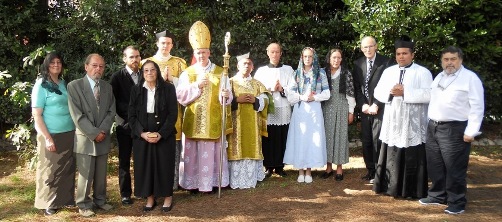
Since this time we have been working with a group of Traditionalist lay
people in South East Kent for some nine years. Our attempt to establish a mission in France has failed due to
the hostility of the local clergy of the Conciliar Church. Need we say
more.
EPISCOPAL LINEAGE/EPISCOPAL SUCCESSION
SCIPIONE CARDINAL REBIBA (1504-1577)
GIULIO ANTONIO CARDINAL SANTORIO (1566)
GIROLAMO CARDINAL BERNERIO O.P. (1586)
ARCHBISHOP GALEAZZO SANVITALE (1604)
LUDOVICO CARDINAL LUDOVISI (1621)
LUIGI CARDINAL CAETANI (1622)
ULDERICO CARDINAL CARPEGNA (1630)
PALUZZO CARDINAL PALUZZI ALTIERI DEGLI ALBERTONI (1666)
POPE PIETRO FRANCESCO(VINCENZO MARIA)ORSINI DE GRAVINA O.P.(1675)POPE BENEDICT XIII
POPE PROSPERO LORENZO LAMBERTINI (1724) POPE BENEDICT XIV
POPE CARLO DELLA TORRE REZZONICO (1743) POPE CLEMENT XIII
MARCANTONIO CARDINAL COLONNA (1762)
HYACINTHE-SIGISMOND CARDINAL GERDIL,B.(1777)
GIULIO MARIA CARDINAL DELLA SOMAGLIA (1788)
ARCHBISHOP CARLO ODESCALCHI S.J. (1823)
COSTANTINO CARDINAL PATRIZI NARO (1828)
LUCIDO MARIA CARDINAL PAROCCHI (1871)
POPE ST. GUISEPPE MECHIORAE SARTO (1884) POPE PIUS X
POPE GIACOMO DELLA
CHIESA (1907) POPE BENEDICT XV
POPE EUGENIO MARIA GUISEPPE
GIOVANNI PACELLI (1917) POPE PIUS XII
ARCHBISHOP SAVEIO RITTER (1935)
JOSEF CARDINAL BEREN (1946)
ARCHBISHOP JOSEPH MATOCHA (1948)
ARCHBISHOP ROBERT POBOZNY (1949)
ARCHBISHOP PAVOL MARIA HNILICA S.J. (1951)
Msgr. EMMANUEL KORAB (1999)
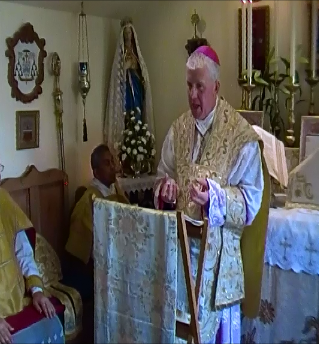
Msgr. MICHAEL PHILIP FRENCH (2004)
The records of Episcopal Consecration for all Roman Catholic Bishops in our Line of Succession, prior to
His Eminence, Scipione Cardinal Rebiba
are located in the Archives of the Vatican.
All of the Popes since December 8, 1700, except for two, trace their Apostolic Succession from the same
His Eminence, Scipione Cardinal Rebiba.
More than 91% of the more than 4,900 Roman
Catholic Bishops alive today, trace their episcopal lineage back to one
bishop who was appointed in 1541 - Scipione Rebiba. Why so many bishops
trace their lineages to this one bishop can be explained in great part
by the intense sacramental activity of Pope Benedict XIII, who
consecrated 139 bishops during his episcopate and pontificate,
including many cardinals, papal diplomats, and bishops of important
dioceses, who in turn, consecrated many other bishops.
The Community holds the SEDEVACANTIS position which is the only logical course for believers in Tradition.
ALL THE CLERGY OF THIS COMMUNITY SWEAR THE OATH AGAINST MODERNISM GIVEN BY HIS HOLINESS POPE SAINT PIUS X
OATH AGAINST MODERNISM
Given by His Holiness Pope Saint Pius X
September 1, 1910.
To be sworn to by all clergy, pastors, confessors, preachers, religious superiors,
and professors in philosophical-theological seminaries.
"I firmly embrace and accept each and every definition that
has been set forth and declared by the unerring teaching authority of
the Church, especially those principal truths which are directly
opposed to the errors of this day.
"And first of all, I profess that God, the origin
and end of all things, can be known with certainty by the natural light
of reason from the created world (see Rom. 1:90), that is, from the
visible works of creation, as a cause from its effects, and that,
therefore, his existence can also be demonstrated.
"Secondly, I accept and acknowledge the external
proofs of revelation, that is, divine acts and especially miracles and
prophecies as the surest signs of the divine origin of the Christian
religion and I hold that these same proofs are well adapted to the
understanding of all eras and all men, even of this time.
"Thirdly, I believe with equally firm faith that
the Church, the guardian and teacher of the revealed word, was
personally instituted by the real and historical Christ when he lived
among us, and that the Church was built upon Peter, the prince of the
apostolic hierarchy, and his successors for the duration of time.
"Fourthly, I sincerely hold that the doctrine of
faith was handed down to us from the apostles through the orthodox
Fathers in exactly the same meaning and always in the same purport.
Therefore, I entirely reject the heretical misrepresentation that
dogmas evolve and change from one meaning to another different from the
one which the Church held previously. I also condemn every error
according to which, in place of the divine deposit which has been given
to the spouse of Christ to be carefully guarded by her, there is put a
philosophical figment or product of a human conscience that has
gradually been developed by human effort and will continue to develop
indefinitely.
"Fifthly, I hold with certainty and sincerely
confess that faith is not a blind sentiment of religion welling up from
the depths of the subconscious under the impulse of the heart and the
motion of a will trained to morality; but faith is a genuine assent of
the intellect to truth received by hearing from an external source. By
this assent, because of the authority of the supremely truthful God, we
believe to be true that which has been revealed and attested to by a
personal God, our Creator and Lord.
"Furthermore, with due reverence, I submit and
adhere with my whole heart to the condemnations, declarations, and all
the prescripts contained in the encyclical Pascendi and in the decree
Lamentabili, especially those concerning what is known as the history
of dogmas. I also reject the error of those who say that the faith held
by the Church can contradict history, and that Catholic dogmas, in the
sense in which they are now understood, are irreconcilable with a more
realistic view of the origins of the Christian religion. I also condemn
and reject the opinion of those who say that a well-educated Christian
assumes a dual personality - that of a believer and at the same time of
a historian, as if it were permissible for a historian to hold things
that contradict the faith of the believer, or to establish premises
which, provided there be no direct denial of dogmas, would lead to the
conclusion that dogmas are either false or doubtful. Likewise, I reject
that method of judging and interpreting Sacred Scripture which,
departing from the tradition of the Church, the analogy of faith, and
the norms of the Apostolic See, embraces the misrepresentations of the
rationalists and with no prudence or restraint adopts textual criticism
as the one and supreme norm.
"Furthermore, I reject the opinion of those who
hold that a professor lecturing or writing on a historico-theological
subject should first put aside any preconceived opinion about the
supernatural origin of Catholic tradition or about the divine promise
of help to preserve all revealed truth forever; and that they should
then interpret the writings of each of the Fathers solely by scientific
principles, excluding all sacred authority, and with the same liberty
of judgment that is common in the investigation of all ordinary
historical documents.
"Finally, I declare that I am completely opposed to
the error of the modernists who hold that there is nothing divine in
sacred tradition; or what is far worse, say that there is, but in a
pantheistic sense, with the result that there would remain nothing but
this plain simple fact?one to be put on a par with the ordinary facts
of history?the fact, namely, that a group of men by their own labor,
skill, and talent have continued through subsequent ages a school begun
by Christ and his apostles. I firmly hold, then, and shall hold to my
dying breath the belief of the Fathers in the charism of truth, which
certainly is, was, and always will be in the succession of the
episcopacy from the apostles. The purpose of this is, then, not that
dogma may be tailored according to what seems better and more suited to
the culture of each age; rather, that the absolute and immutable truth
preached by the apostles from the beginning may never be believed to be
different, may never be understood in any other way.
"I promise that I shall keep all these articles
faithfully, entirely, and sincerely, and guard them inviolate, in no
way deviating from them in teaching or in any way in word or in
writing. Thus I promise, this I swear, so help me God. . ."
« Ut unum sint »
An Address to
Sedevacantist Roman Catholic Independent Priests
To foster unity of Sedevacantists and to avoid fragmentation, our Community offers in all humility the following:
A Confraternity
of sedevacantist Independent Roman Catholic
Priests
The Confraternity of Sedevacantist Independent Traditional
Roman Catholic priests is a voluntary and fraternal association of
Traditional Roman Catholic Priests who are functioning independently. Priests who exclusively follow the Tridentine Rite Codified by Pope St. Pius V, and hold the Sedevacantist view.
Secular priests have the right to join the Confraternity for the purpose of benefiting the clerical state.
Aims of the Confraternity
1. To foster unity among Sedevacantists Independent Traditional Roman Catholic priests.
2. To share the same values and foster unity and the fullness of priestly life and ministry.
3. To be under Episcopal oversight as required by the Canon Law.
4. To work independently and encourage faithfulness to the priestly life and to honour the Blessed Trinity.
Fundamental requirements for the priest to join
1. Authentic Catholic Faith
2. Profession of the Anti-Modernist Oath.
3. Adherence to SEDEVACANTIST POSITION.
4. Adherence to the Augustinian spirituality.
5. Regular contact on activity on regular basis.
6. Three yearly ad limina to the Bishop’s Priory in Great Britain.
7. Annual contribution to support the mission.
Due to evident Administration problems, We must limit this offer to Europe and America.